Italy’s Anti-Surrogacy Movement Goes Back to the Renaissance
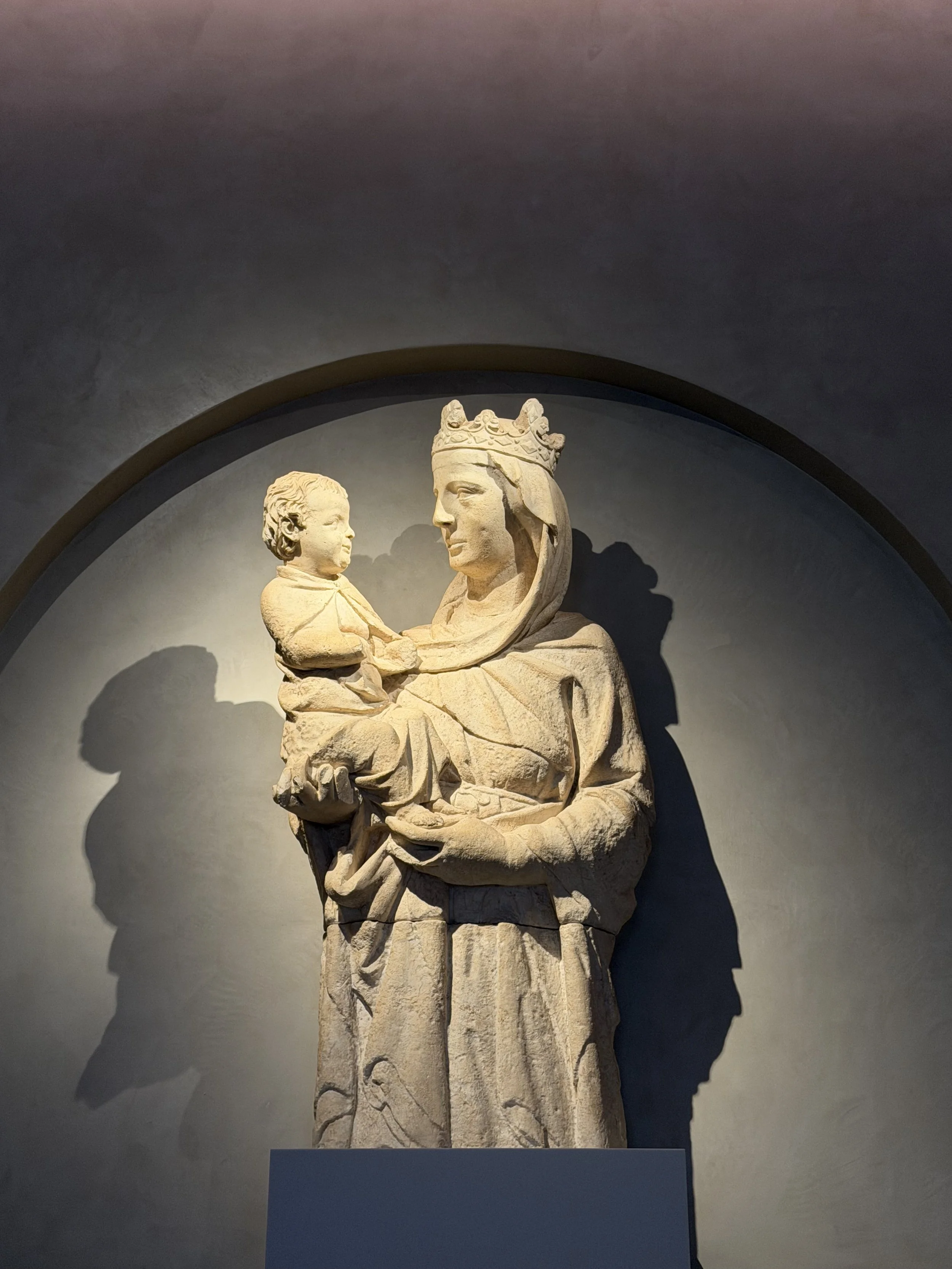
Giovanni Pisano’s famous Madonna and Child in the Museo dell’Opera del Duomo in Pisa.
I had the pleasure of visiting one of my best friends in Tuscany, which you can see highlights of on my Instagram.
It was an amazing trip filled with delicious pasta and incredible art. However, there was a theme in the art that made me realize how deep the anti-surrogacy movement runs in Italy.
Italy is the only country in the world that bans international surrogacy, and they have made it a crime punishable by up to two years in prison and a fine of up to 1 million Euros. This is the culmination of years of work against gay and lesbian parents in Italy.
While the law has been in place since the end of 2024, as of January 2026, no one has yet to be persecuted for it. However, gay Italian dads who underwent surrogacy in the United States are too afraid to return to their home country for fear of persecution.
How did Italy get to this extreme of anti-surrogacy? Based on my recent trip, I think it started about half a millennium ago.
Italy’s Obsession with Mother and Child
The Renaissance was an incredible time in European history that spawned new forms of art, science, literature, and philosophy. We all learn about it in school, and some of us (myself included) had the nerdy pleasure of going to Renaissance Faires growing up.
The Italian Renaissance influenced all of Europe and the New World. For the next couple centuries, the most famous art in the world would heavily feature the Holy Family of Mary, Joseph, and the baby Jesus.
As a former Catholic who went to Catholic school until college, I can tell you that we all know the real stars of the Holy Family are Mary and Jesus. Joseph was a good guy, but he is ‘technically’ not the father of Jesus (that’s God). But Mary, she is the real deal. She is the one true Mother of God.
There are countless works of art in Italy alone that feature this dyad of the Madonna and her Child. As the Renaissance was the first time that artists were able to capture visceral human emotion in carving and painting, this profound connection between Mary and Jesus became visible to the public for the first time.
At least a billion Catholics over the last 500 years have constantly been shown this connection. They see it as one of a kind, irreplaceable, and - in a word - divine.
And, as I learned on my trip, Italians see it almost every day as this art is ingrained into their lives through museums, churches, and the countless other religious vestiges of the Renaissance scattered throughout the cities.
So, when Prime Minister Meloni and her right wing government say that they want to ‘protect families and children’ by banning all forms of surrogacy - where they inaccurately argue that children are ‘taken’ from their mothers - of course the Italian populace would agree. I mean, look at Mary and Jesus. How could you separate them and ruin this divine connection?
How Do Major World Religions View Surrogacy?
It’s not just art that tells Italians surrogacy is wrong. It’s their religious leader. While the previous Pope was extremely anti-surrogacy, the current American Pope is similarly against assisted reproduction for gay people.
While Catholics are not the only religion opposed to surrogacy, there is more variety in other major global religions.
An article in the Journal of Assisted Reproduction and Genetics did a comparison of the perspectives of assisted reproductive technology (ART) and gestational surrogacy across religions:
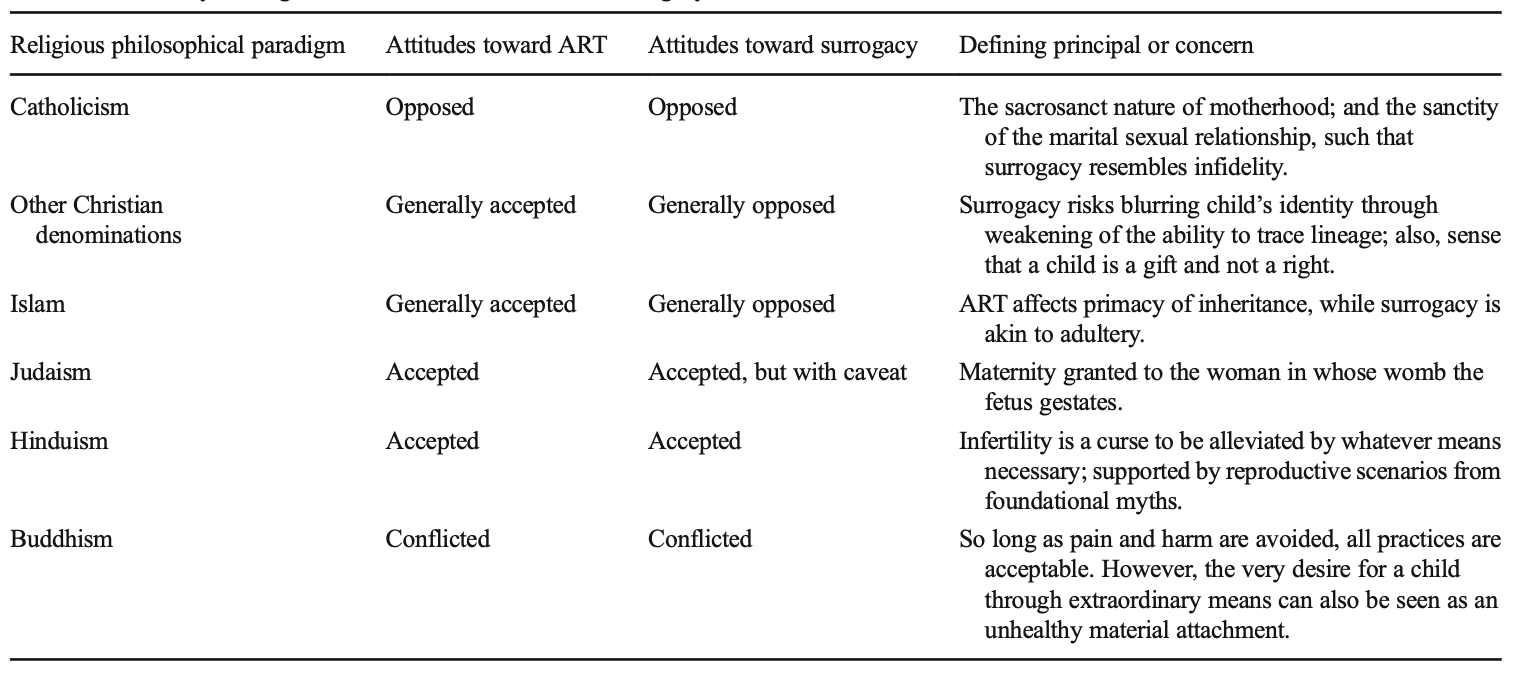
Summary of religions’ attitudes toward ART and surrogacy
The sacrosanct nature of motherhood, as evidenced by Renaissance art and current Italian political ideologies, mark Catholicism as strictly opposed to any ART or surrogacy. However, other religions, even other Christian denominations, are less absolute in their beliefs.
Focusing on surrogacy only, Hinduism is the only belief system that accepts gestational surrogacy without caveats. For Judaism, there is not an ethical dilemma but more of a parentage and cultural challenge, as the surrogate is considered the mother. Because Judaism is inherited through the maternal lineage, this is a challenge if the gestational surrogate herself is not Jewish and the intended parents (IPs) are. Buddhism is described as ‘conflicted,’ but as long as harm is avoided the practice is acceptable.
While non-Catholic Christians are willing to allow ART, they and Muslim people are generally opposed to surrogacy due to the issues of identity and adultery. These are both illogical arguments to me. Identity comes from your genetics and parents. In the case of ART, these may not be the same people, but they can still be known to you. A major factor for my husband and I in choosing an egg donor was that she would not be anonymous and could be contacted in the future by our child. With regard to adultery, there is no sex involved. This is a medical procedure.
Rational arguments and religion do not often go hand in hand. However, I think it’s interesting that Catholicism is still the most anti any form of assisted reproduction and surrogacy of all the world’s religions, and I do believe this started with the Renaissance and has been reinforced for centuries since.
Modern Europe: Less Religious But Still Mother-Child Focused
While Italy is not the only Catholic country in Europe, it is also not the only country in Europe opposed to surrogacy.
European Union (EU) and European Economic Area (EEA) countries that have domestic surrogacy bans include Germany, France, Spain, Norway, Finland, Iceland, Switzerland, Austria, and Estonia.
While some countries, such as Ireland and Denmark, are working to update and provide regulations for ethical international and domestic surrogacy, the majority of the continent is opposed to surrogacy.
While less acute and omnipotent as Italy’s Madonna and Child, I believe that all of Europe still has an unhealthy attachment to the ideal of mother and child. Make Mothers Matter presented their ‘state of motherhood’ at the EU Parliament in 2025.
Don’t get me wrong. Mothers do matter. Also, surrogates definitely do matter, but surrogates or gestational carriers are not the mother of the child. They have no intention or desire to be a mother, and that is what matters. Also, shouldn’t all types of mothers, even those who utilized ART or surrogacy to become mothers, matter? Shouldn’t fathers matter? What about single parents? Shouldn’t all parents - intended and through assisted reproduction and those through unassisted means - matter?
I am aware that in the modern era, the ‘burden’ of childcare in most countries still falls disproportionately on women. However, shouldn’t the EU and its Parliament, a bastion of equal rights and feminism, focus on things like leave, mental health, and child care of all parents and highlight this disparity in order to make society more equitable? By focusing on these as mother-only issues, they are perpetuating the stereotype that mothers have to do all these things.
I think European countries need to move away from the ideal of motherhood to the reality of parenthood. I think if countries start viewing all types of parents, regardless of sex, sexual orientation, or pathway to parenthood as valid, then this will benefit all families and children.
I believe we have to move on from romanticizing Renaissance ideals of maternal love in the past and start celebrating the amazing connection that all parents have with their children in the present. We can appreciate great art, but life does not always have to imitate art. Life can evolve beyond what has been carved in stone over 500 years ago.
