Gay Dads Have the Same Child Attachment as Lesbian and Straight Parents

‘Attachment’ refers to the relationship between an infant and a parent where an infant displays a tendency to seek comfort and protection from their parents when they feel scared, anxious, or vulnerable.
This attachment has been shown to be critical to a child’s future social development and mental well-being.
Essentially, the relationship infants have with their parents is foundational to all future relationships they have with others and even themselves.
Previous research has shown that older children of gay parents are doing exceptionally well from a mental health perspective, sometimes even better than children of straight parents. I have previously written about the strong intent and supportive environment that children through surrogacy come into the world with gay parents. I believe this could have a profoundly positive effect and could be part of the explanation for this previous research showing how well-adjusted the children of gay parents are.
However, gay parents are more likely to experience ‘minority stress,’ meaning they are exposed to chronic stress due to stigma, discrimination, and/or social marginalization. Could this stress have an impact on their parenting and attachment in the first year of their children’s lives?
The Study Design: Strange Situation Procedure (SSP)
The study included:
38 families with two gay dads
61 families with two lesbian moms
41 families with a mother and a father
Families from the United Kingdom (23.6%), the Netherlands (33.6%), and France (42.9%)
All families had used assisted reproduction to have their children
The gay dads were older (average age of almost 39 years), had been in a relationship longer (over 10 years on average), had twins (37.5%), had higher salaries, and more often lived in large cities compared to lesbian and straight couples. Interestingly, this mirrors my husband and I in terms of our demographics and relationship, but we are not planning on having twins.
The children’s attachment was evaluated twice, once at around 4 months of age and a second time at around 12 months old. The study used the Strange Situation Procedure (SSP), which is a well-validated tool for assessing infant attachment that has been used since the 1970s. This is the first study to use this tool for gay parents, and it’s important that they used an extensively tested and vetted procedure to evaluate attachment. This makes the results extremely robust and allows them to be compared across a large number of previous studies that used the same tool.
The SSP categorized the attachment in 4 groups, which are broadly defined as the following:
Secure: Infant shows distress when a parent leaves the room and seeks comfort when they return.
Insecure-avoidant: Infant seems more focused on exploring their surroundings and seldomly seeks contact with their parents.
Insecure-ambivalent/resistant: Infant shows distress before being separated and struggles to find comfort with the parent.
Insecure-disorganized: Infant is conflicted, confused, or fearful towards their caregivers.
The study also evaluated each parent, given there were two assessment times, so this controlled for bias in terms of a ‘primary caregiver’ role.
The Results: Children Are Well Attached to All Types of Parents
The results showed no differences between the different parents types. Gay dads, lesbian moms, and straight moms and dads all had the same distribution of attachment types to their children.
Table 3 here summarizes these results by parent and attachment type:
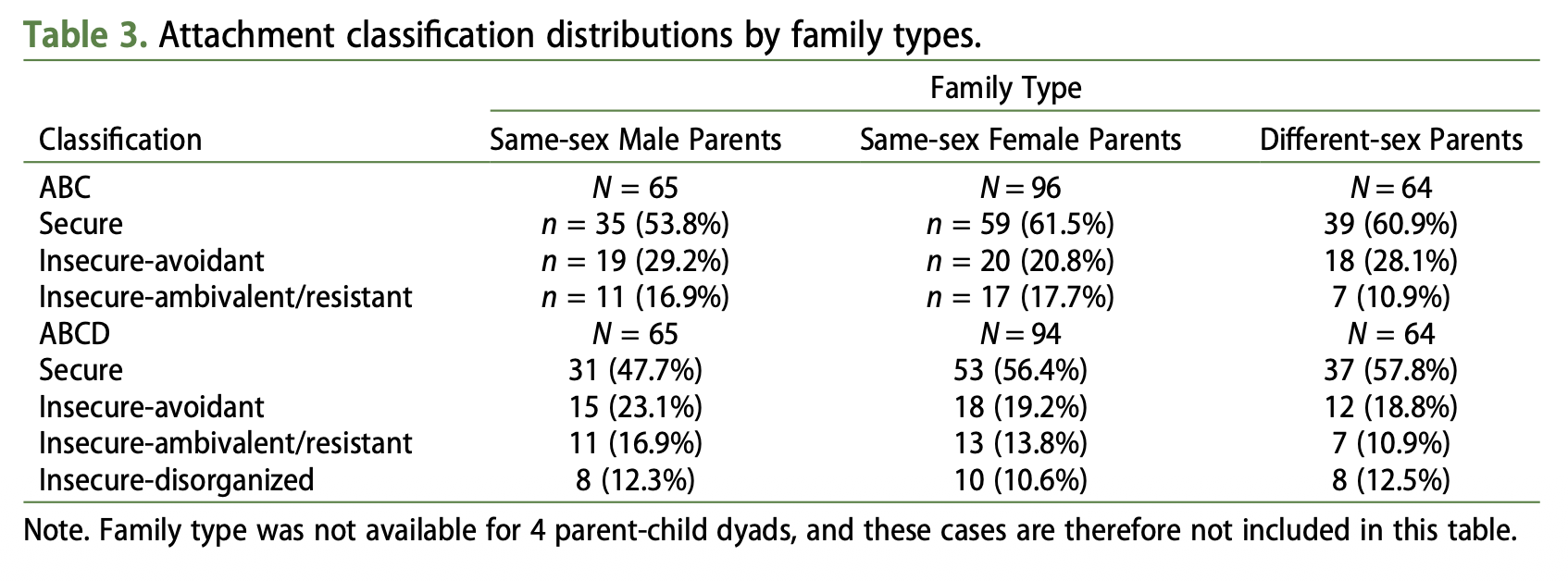
Even when additional sensitivity analyses were done to account for the different characteristics described above (i.e. relationship duration, income, age, etc.), there were no differences in the attachment and parent types.
While there was no difference with regard to the parent types, there were differences with regard to the countries. The study found that attachment was more secure in families from the Netherlands and France compared to the United Kingdom. The authors considered that the more generous parental leave in the Netherlands and France could have contributed to more infants being securely attached.
Another comparison that was interesting compared the results of this study to an earlier meta analysis of over 20,000 SSPs for parental attachment. This found that the percentage of securely attached children in this study (53.7%) was almost identical to the previous meta analysis (51.6%).
This is strong evidence that children from diverse family forms and through assisted reproduction are just as likely to develop secure attachment relationships as children traditionally conceived all over the world. This was the power of using the well-valided SSP tool for the study. Comparisons to other studies of children for the last 40 years can be made and demonstrate how gay dads, lesbian moms, or any parents using assisted reproduction can feel confident that they are just as likely to have a secure attachment to their children.
Conclusion: Validation of Our Family Building Choices
This is a novel study that utilized a well validated tool for infant attachment and strongly demonstrated that gay dads and lesbian moms are just as securely attached to their children as straight parents.
The difference in countries and possible connection to parental leave demonstrates that child attachment is more about the quality and time parents spend with their children, and not whether that is with a mother, father, two mothers, or two fathers.
The message of this study for intended gay dads and the world opposed to surrogacy is powerful: The kids don’t care. The kids are all right. The kids don’t care who their parents are in terms of gender. The kids will feel secure if the parents are allowed to parent.
As a gay intended dad in Sweden who is counting down the months until I can take my generous year long ‘pappaledig’ (dad leave in Swedish) with my husband, this study gives even more support to our choice to move to Sweden to have our family. Here we will be given time during the first year of life to bond and securely attach with our child. I’m not saying this isn’t possible in other countries or with less parental leave, but Sweden offers this benefit. Based on this study, parental leave duration has an impact on infant attachment, so why not take it?
